
Patient Payments at athenahealth
athenahealth’s cloud-based enterprise software provides medical practices with clinical, billing, and patient engagement solutions. I’ve spent 6 years working on patient-facing payment solutions—navigating complex design challenges such as bringing trust, empathy, and clarity to medical billing, as well as offering flexible and simple ways to pay. This work helps practices get paid more, faster, with less operating cost. athena’s payment workflows have seen 30M monthly users and collected $2.5B in annual payments.
My work has driven UX strategy & vision, influenced roadmaps, and shaped how we design for patients.
Crafting a Patient Pay Strategy & Roadmap
User Research | Vision & Strategy | Opportunity Analysis | Roadmapping | Workshop Facilitation
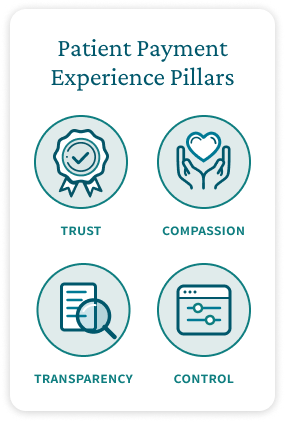
I led the foundational research and strategy behind a new patient payments roadmap, uncovering why patients and practices weren’t adopting autopay and challenging leadership’s assumption about what to build first. I then facilitated the cross-divisional workshops that aligned three teams around a joint roadmap. The UX strategy and experience principles from this work guided patient pay design for 5+ years. As the roadmap shipped, autopay usage more than doubled.
Bringing Autopay Authorizations to Self Check-In
Strategy | User Research | Feature Definition | UX/UI Design | RITE Testing | Cross-team Collaboration | Spec-Driven Development
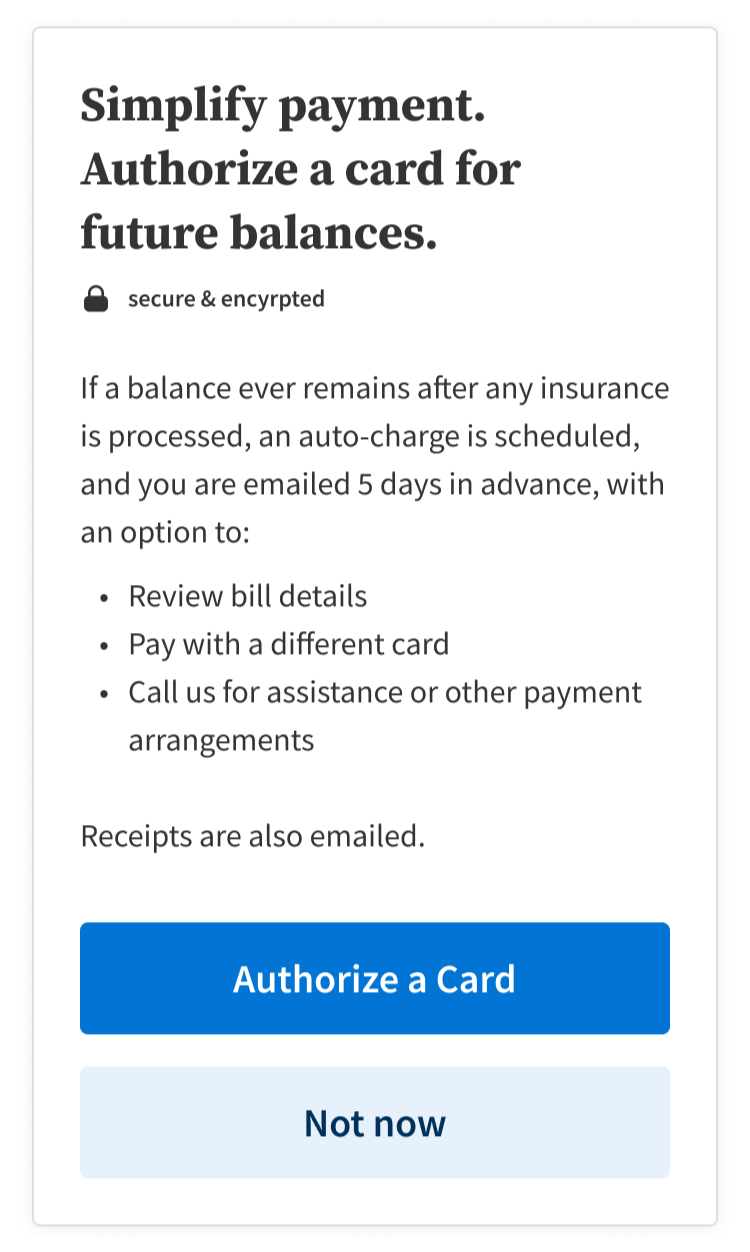
I led user research to explore the viability of a feature vocal clients were requesting. While competitors leaned on vagueness and hidden opt-out to drive conversion, I successfully built the case for prioritizing patient trust. I helped the team scope the feature and navigate risks, tested feature options and pitch messaging, and handled detailed design and implementation across both practice- and patient-facing workflows. The initial release achieved meaningful conversion and fewer cancellations, which had significant revenue impact. A follow-up phase became our team’s first project with a new AI-first spec-driven development process, for which I wrote UX specs and helped the team navigate the new process.

Defining an AI Billing Assistant
User Research | AI System Prompts & Testing | UX/UI Design | Process Design
When leadership asked us to bring a specific AI feature to our patient experience, I worked to uncover the underlying goal behind the assumptions and offered a compelling alternative that Product adopted. I wrote AI system prompts, helped create an evaluation framework for AI outputs, explored new AI interface patterns, and helped the team navigate our new AI-first process – in collaboration with product and engineering partners, a content expert, and other designers.
Expanding Payment Plan Setup
User Research | Feature Definition | Strategic Oversight | Mentorship
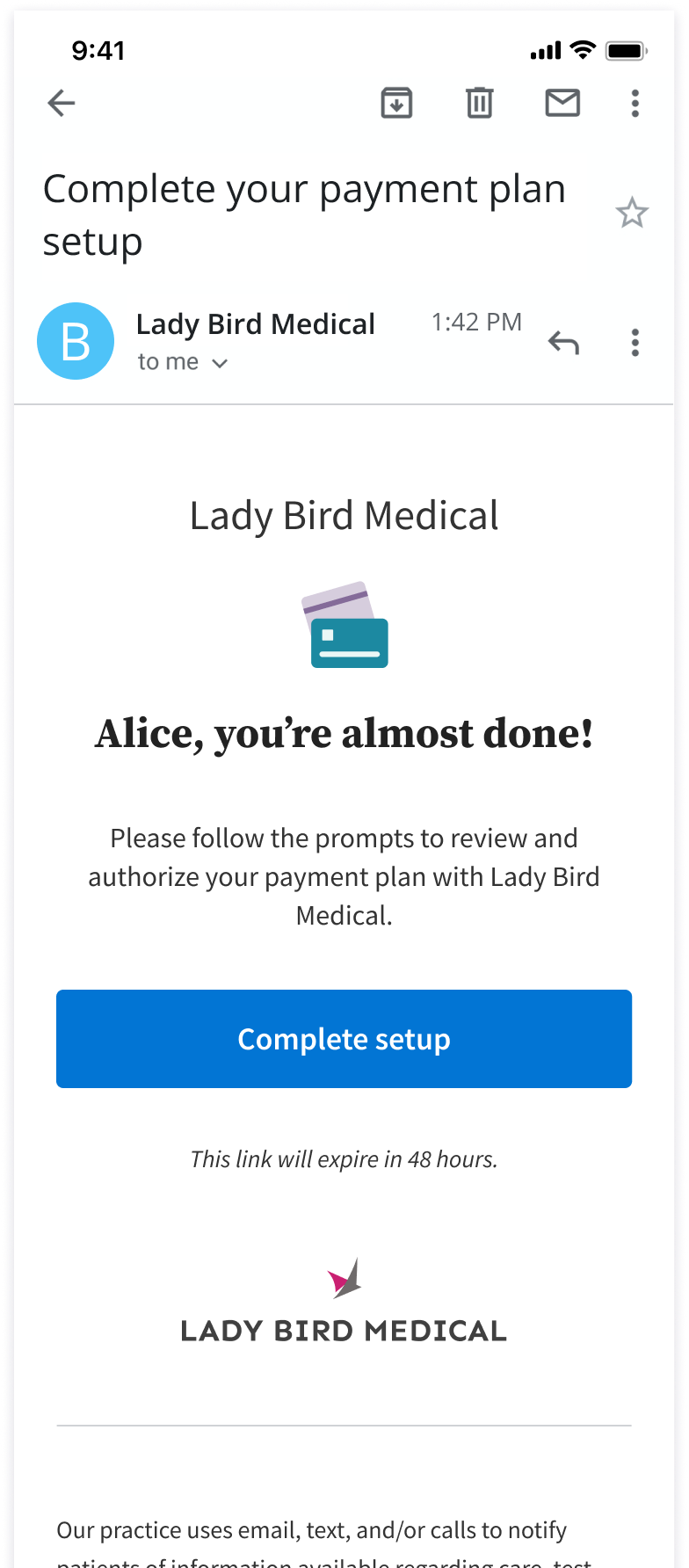
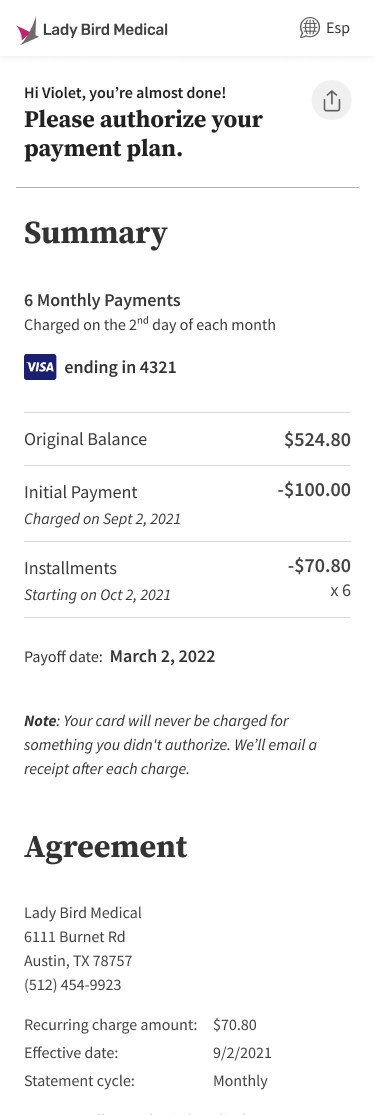
After identifying roadmap opportunities during the foundational patient payment research (case study above), we built two features to increase the share of payment plans on autopay. I set the UX strategy, helped scope both features end-to-end, and directed the patient-facing designs to ensure UX goals were met.
Practice-initiated Digital Consent lets staff create an autopay plan and send the authorization for the patient to review and sign digitally, then confirms consent back to the practice. The UX was strategy to give patients the clarity and reassurance staff doesn’t alway provide, a gap our research surfaced. The autopay rate rose 7 percentage points after launch, and 91% of surveyed patients said the workflow made them more comfortable with autopay.
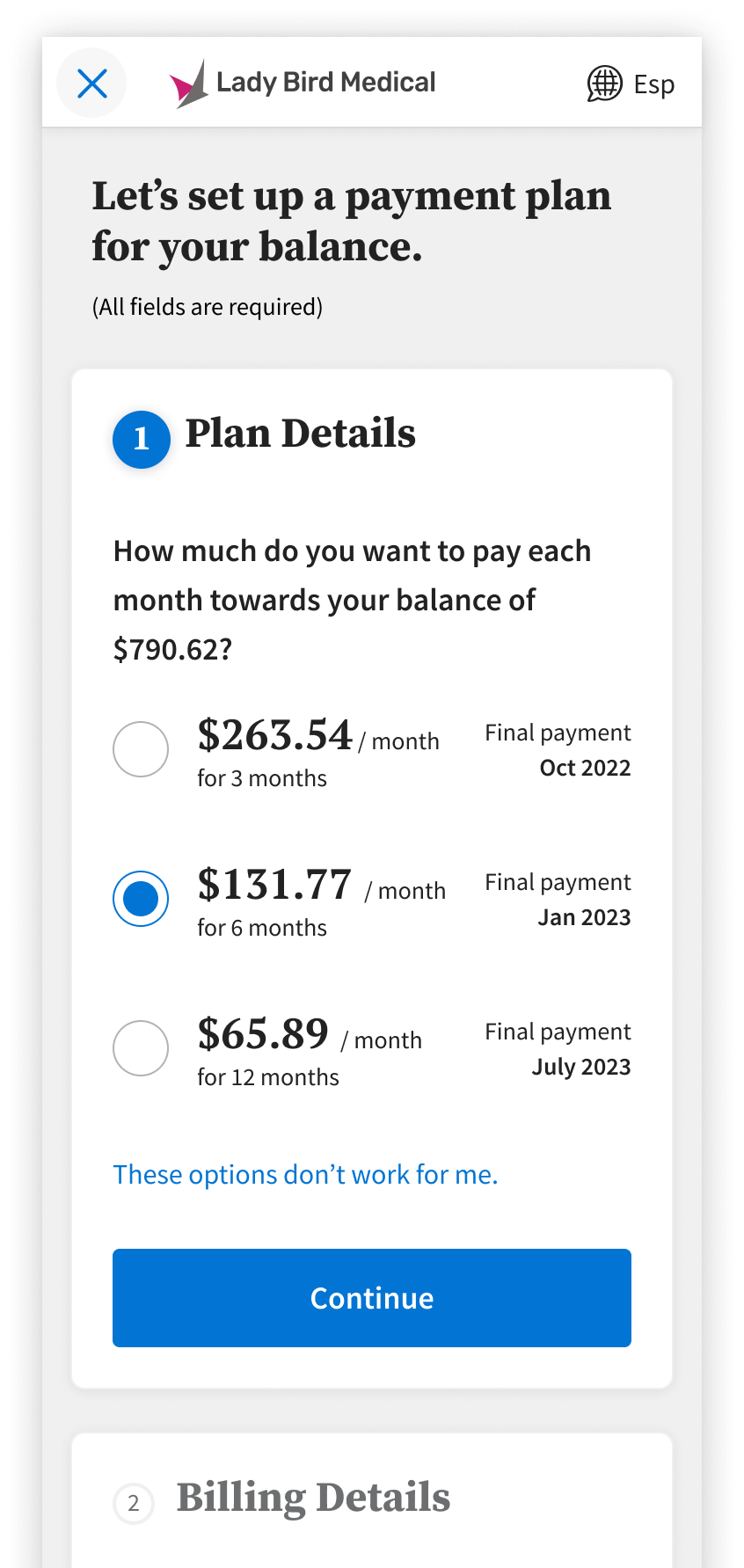
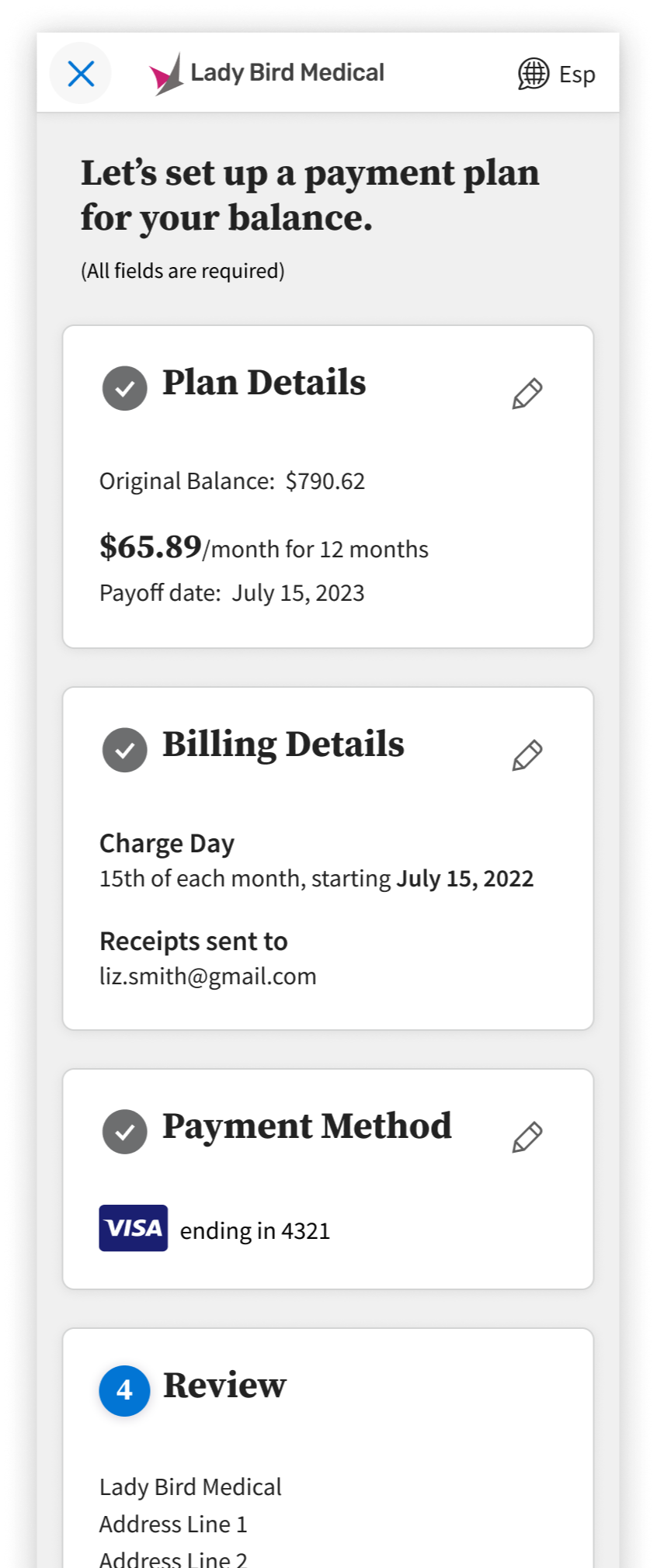
Patient-initiated Enrollment lets patients set up an autopay plan themselves within our new practice-defined limits. Research showed how anxious patients feel receiving an unaffordable medical bill, so the strategy was to provide clear reassurances, enough options to feel in control but not overwhelmed, and an option to contact the practice for additional flexibility. The autopay rate rose another 20 points after launch, and 93% of surveyed patients reported satisfaction with creating a payment plan.
The UX intern I hired and mentored on this work secured a full-time role and continued to impress the team with detailed designs, as I guided her closely.
Earlier Work at athenahealth
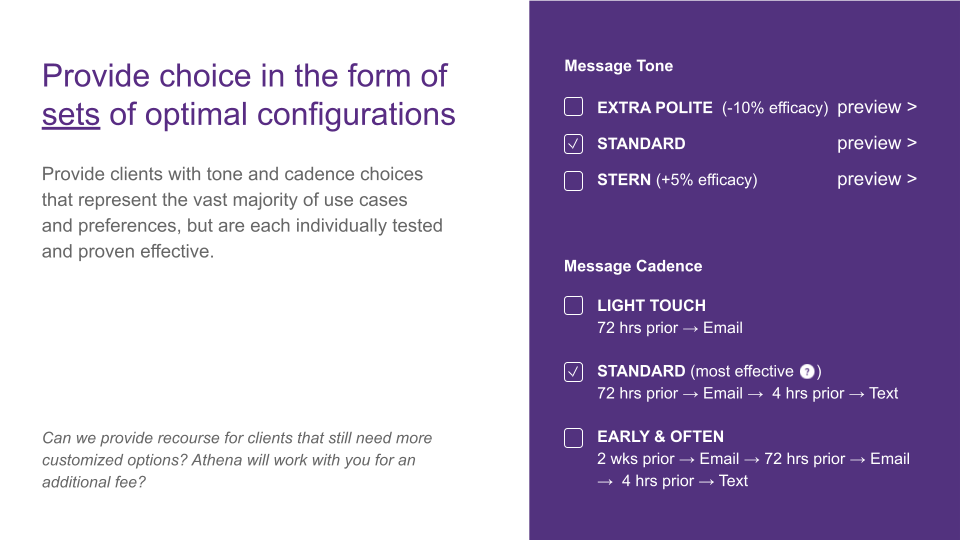
Reframing Configuration Needs for Patient Messaging
User Research | Stakeholder Research | UX Strategy & Vision
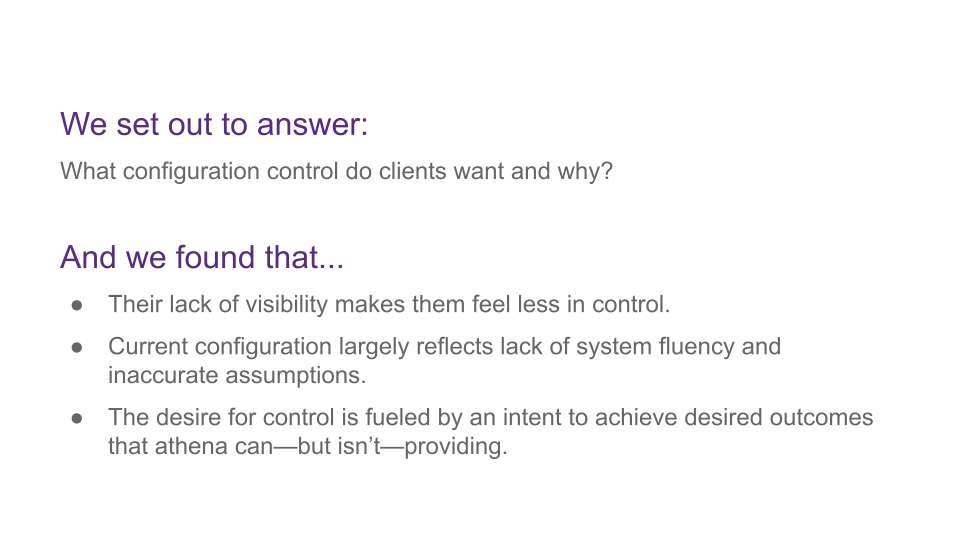
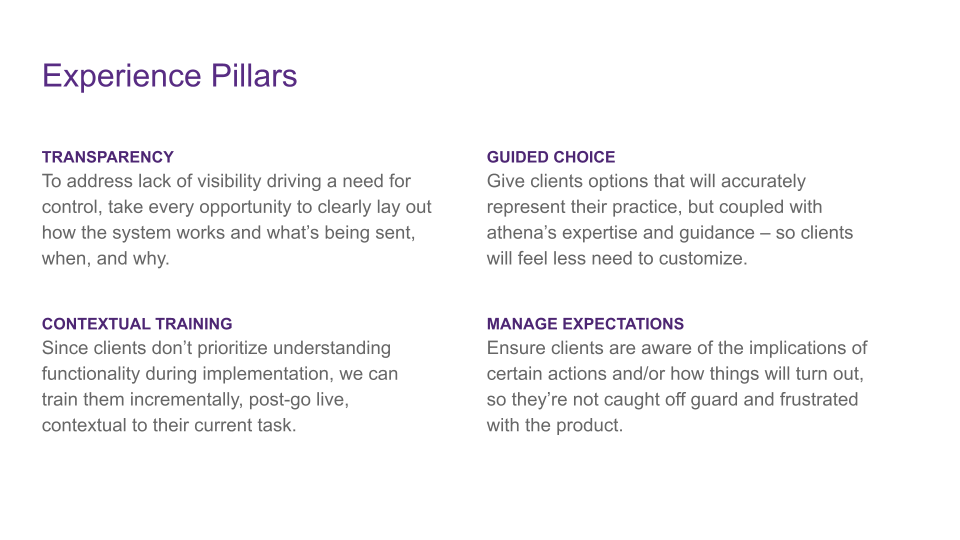
Practices were asking for fine-tuned configuration control over patient email and SMS messages, but leadership was skeptical. Not only was it a high LOE; they’d also seen practices customize messages in detrimental ways, and felt more control might degrade outcomes. Product and I conducted user research to determine what control might be warranted. By getting to the “why” behind the desire for control, I found we could address the underlying need with lighter-weight, less risky configuration options. This strategy would maintain optimal outcomes, prevent practice configuration burden and mistakes, and lower the implementation cost to athena.
Envisioning a Faster Patient Self Check-in Experience
User Research | Workflow Audit | Visioning
Practices needed patients to complete digital check-in before the visit to avoid intake bottlenecks that put the schedule behind. However, the workflow was long and linear, with form after form asking patients to review every field, every visit – even for information that rarely changes. To help increase completion rates, I created a vision for a hub-and-spoke experience with more navigational control, better visibility into the time and information required, and the acceleration of editing only what’s needed. A new dynamic approach would let practices configure review frequency and would sort information into what’s asked every visit, what must be reviewed periodically, and what’s only available for edit. This required a new data model, but presented a big opportunity to limit drop-off. My vision reshaped the team’s approach, and Product secured the investment to pursue the overhaul as part of a larger initiative, with two full-time product teams for 5+ years.
Agency Work
At Fjord, my UX experience included discovery research, high-level strategy & vision, feature definition, detailed wireframes, user testing, and interaction documentation.

Life Science Research Platform
User Research | Product Definition | Interaction Design
To help the client define their vision of a cloud-based platform for life science researchers, I worked closely with a team to conduct stakeholder and user research and then define adoption strategy, MVP scope, and information architecture. I handled all interaction design for the detailed vision work.

Rental Car Website
Interaction Design
Working with a team of UX, Content, and Visual designers, we redesigned the booking website for a leading rental car company with complex requirements. My interaction design work included concepts, wireframes, prototypes, and interaction notes.

Drilling Fluids Advisor
User Research | Visioning | Interaction Design
The client needed a proof of concept to test the feasibiity of a complex tradeoff analysis platform built on IBM Watson. I handled user research, vision concepting, detailed interaction design for a test site, and future phase conceptual wireframes for the complex interface.