Crafting a Patient Pay Strategy & Roadmap

I led the foundational research and strategy behind a new patient payments roadmap, uncovering why patients and practices weren’t adopting autopay and challenging leadership’s assumption about what to build first. I then facilitated the cross-divisional workshops that aligned three teams around a joint roadmap. The UX strategy and experience principles from this work guided patient pay design for 5+ years. As the roadmap shipped, autopay usage more than doubled.

Tools

UserTesting.com, Qualtrics, Airtable, Mural, Figma, Confluence

My Contribution

User Research & Synthesis, UX Vision & Strategy, Experience Principles, Solution Ideation, Opportunity Analysis, Workshop Facilitation, Executive Influence

Collaborators

Product Manager, Product Area Directors


Challenge: Find the roadmap opportunities in a new product area

After years without investment, a new Patient Payments team was formed to help practices collect more of their patients’ balances, faster, and with less operating cost. We needed a roadmap. Leadership expected our first project should be online patient enrollment in Payment Plans to help collect larger balances, and were interested in maximizing autopay plans. They also suspected the Card on File feature was a major opportunity—since it auto-charged any new patient balance. To help inform a new roadmap, my Product Owner and I were tasked with understanding the opportunity spaces around Payment Plans and Card on File. ​

Definitions

Card on File – After insurance is processed for a visit, any remaining patient balance is auto-charged. The patient is notified 5 days before any charges.

Payment Plan – Unaffordable bills can be split into monthly installments via auto-charge or manual statements.

Autopay – Refers to either an Autopay Payment Plan or a Card on File arrangement.

“As a new zone still defining its vision and strategy, we made a very intentional choice to set business goals around gathering data and developing expertise necessary to generate an informed roadmap. In partnership with product management, Sara led and executed the discovery work that made achieving this goal possible.”
— UX Director / Manager
 

Our Desk Research revealed significant autopay opportunities & obstacles.


After auditing the current state system and previous work, reviewing existing practice feedback and feature analytics, and meeting with internal SMEs, it became clear:

  • Cross-divisional partnership was needed ASAP. Our team sat in Patient Experience, but this dual-facing product area also required practice-facing teams in another division, with their own leaders, budgets, and deadlines. That barrier had stalled progress before, so we started lobbying for partnership.

  • Increasing autopay utilization could have enormous impact. Autopay was an effective lever for all 3 metrics, but barely used.


I led User Research to identify autopay adoption blockers for both practices and patients.

Methodology

I paired the qualitative depth of interviews with surveys for scale.

Card on File
  • Ran a practice survey to surface gaps and opportunities, then practice interviews with high-, medium-, and low-adopters to dive deeper into the “why” and capture feedback on solution ideas.
  • Conducted patient interviews with adopters and non-adopters, developed a hypothesis that reassurance would increase adoption, then tested it with a patient survey.
  • In both cases, adopters revealed benefits and successful strategies, while non-adopters revealed their blockers.
Payment Plans
  • Gathered patient insights with a think-aloud patient survey (which captures the “why” in audio) and patient interviews.
  • Conducted practice interviews to surface their needs, then a practice survey to confirm findings at scale.


I built rich documentation for the years ahead.


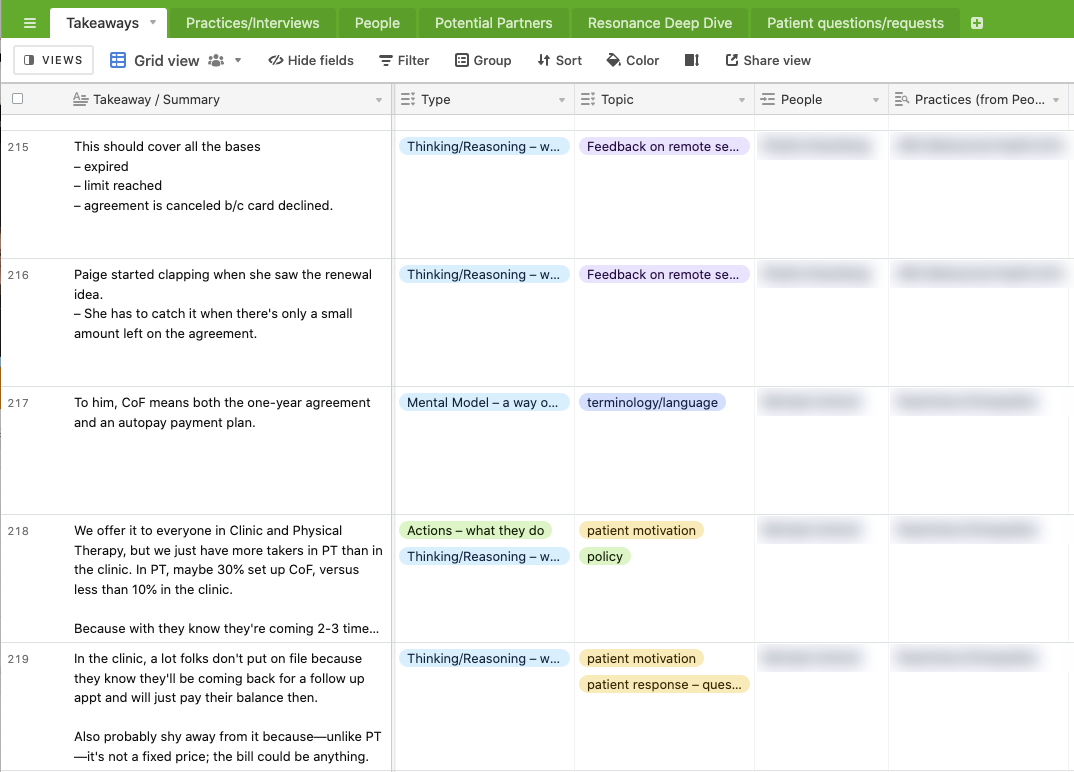
I aggregated and tagged utterances in an Airtable database that served as both synthesis and long-term reference (a process I’d use AI tools for today).

In addition to audience-specific readouts, I maintained a comprehensive research deck or “mega deck” as a living document with all research – every study’s questions, methodology, findings, links, recommendations, etc.

Airtable table of user research takeaways on card-on-file payments, with columns for type, topic, and people.
“Your Autopay MegaDeck from a few years ago will stay open forever in my Chrome browser because of its thoroughness and relevance. Your discovery outputs are comprehensive and include questions and answers that I doubt anyone else would have considered until it was too late. ”
— Cross-divisional product partner (onboarded a year later)


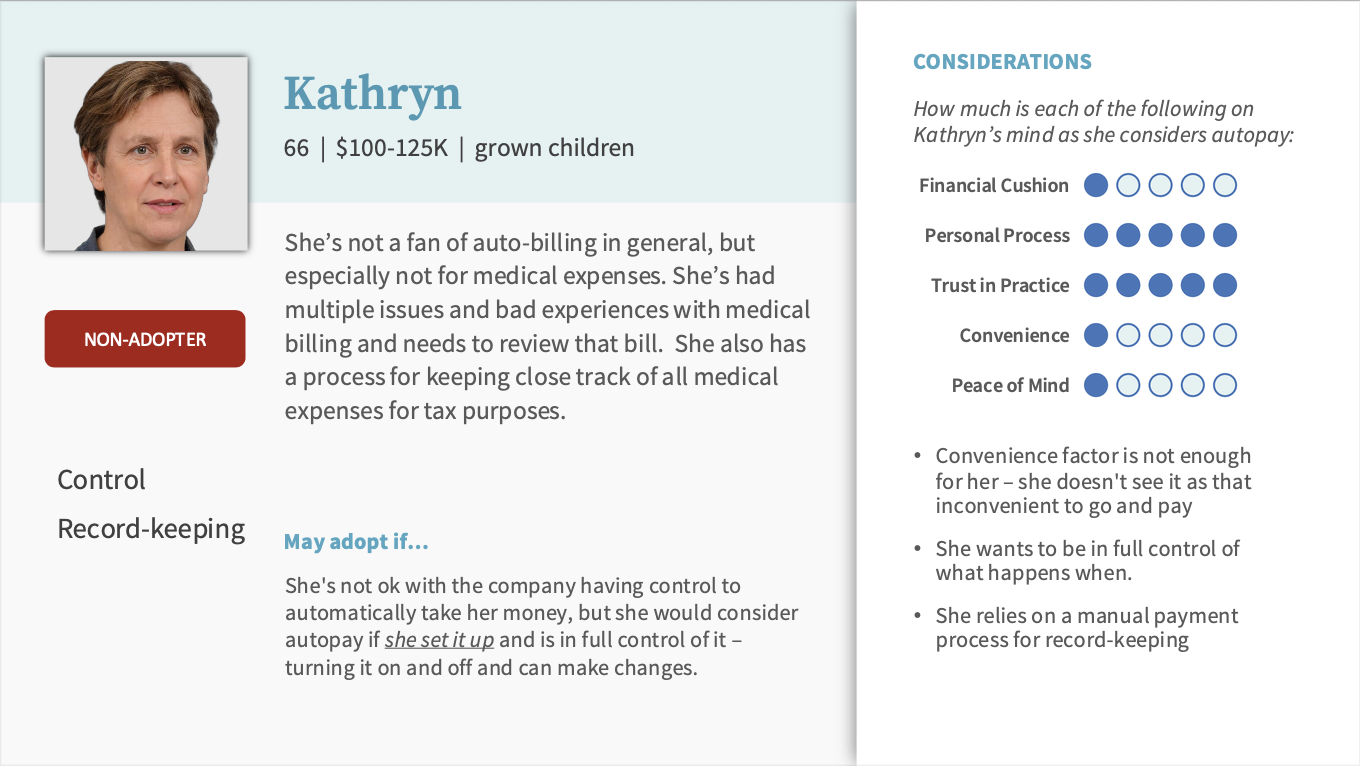
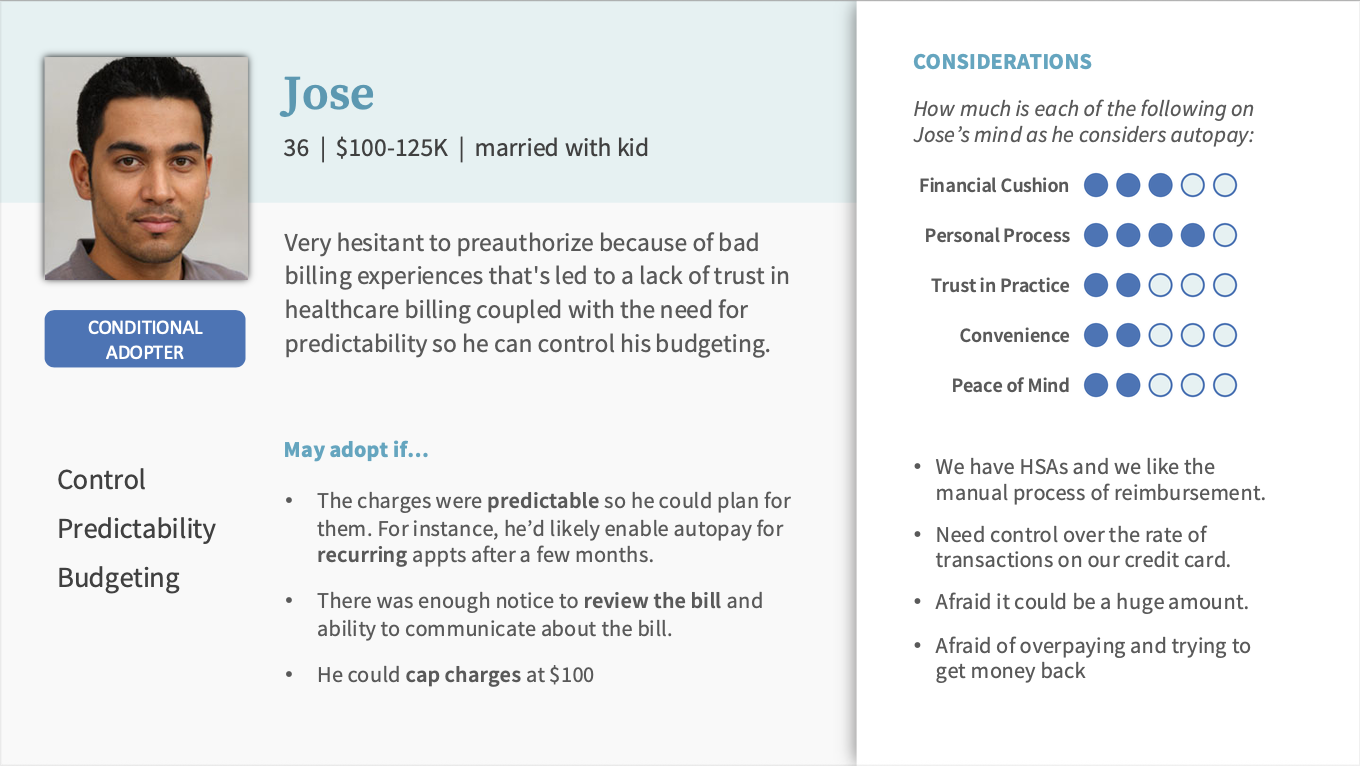
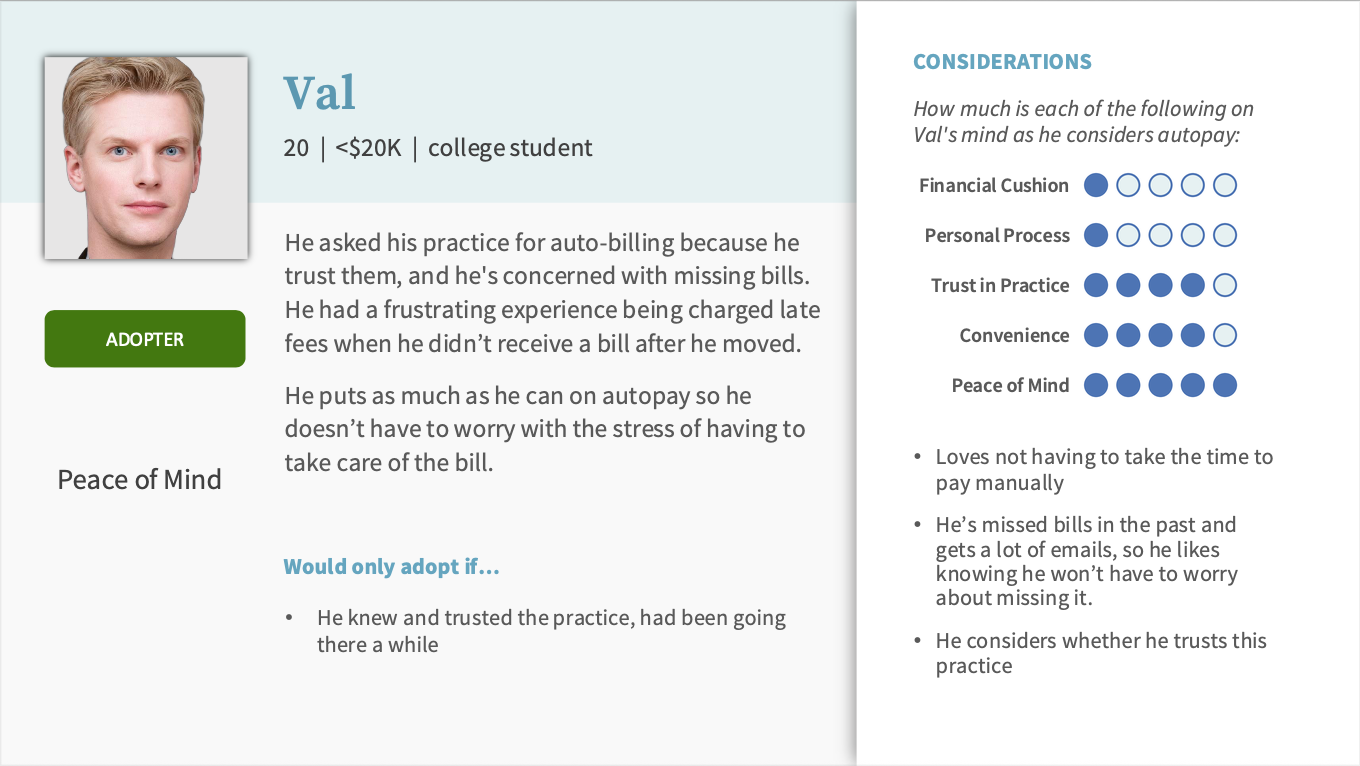
Profiles helped tell patient stories.

I created a profile for each patient I interviewed. These helped illustrate patients’ stories in readouts and sometimes served as personas for the work ahead.


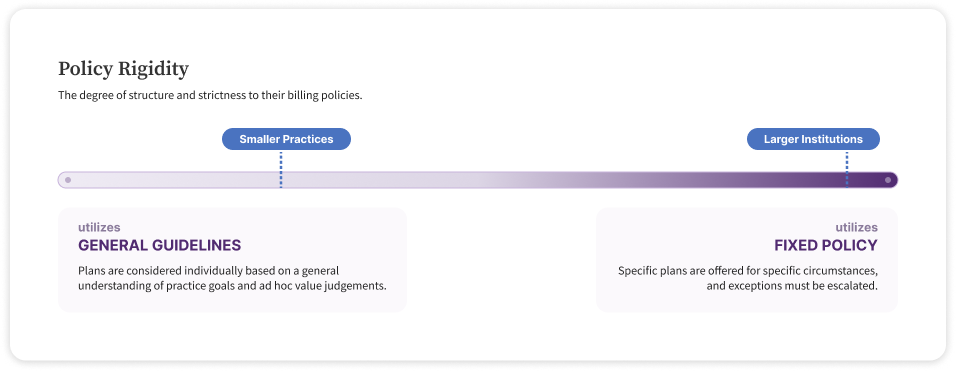
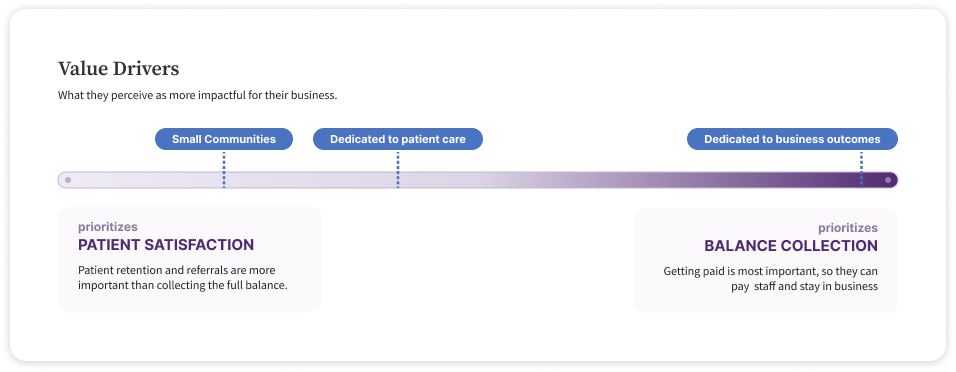
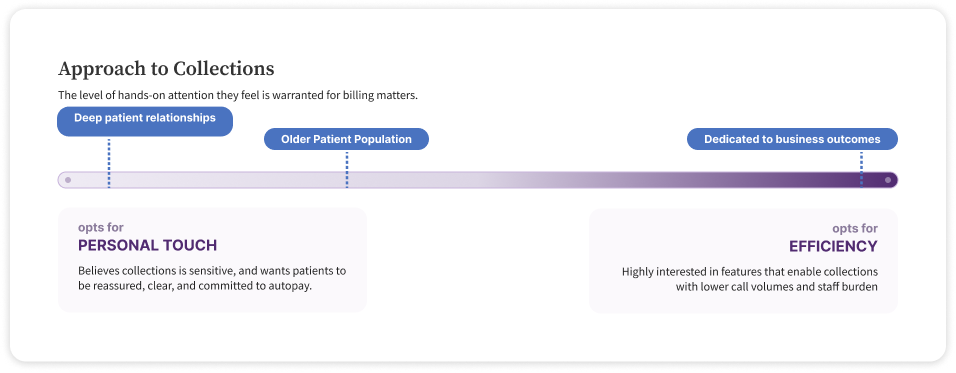
Attribute spectrums helped illustrate practice adoption drivers.

Practices varied widely in their values, approaches, and policies. I created these spectrums to illustrate a few core attributes that impacted their mindset on autopay.

“Sara uses her storytelling superpower to amplify the voices of users and their true experiences to help us better meet the needs of our customers and their patients.”
— UX Director / Manager


Findings: Research revealed three big roadblocks to autopay adoption.

Across Payment Plans & Card on File:

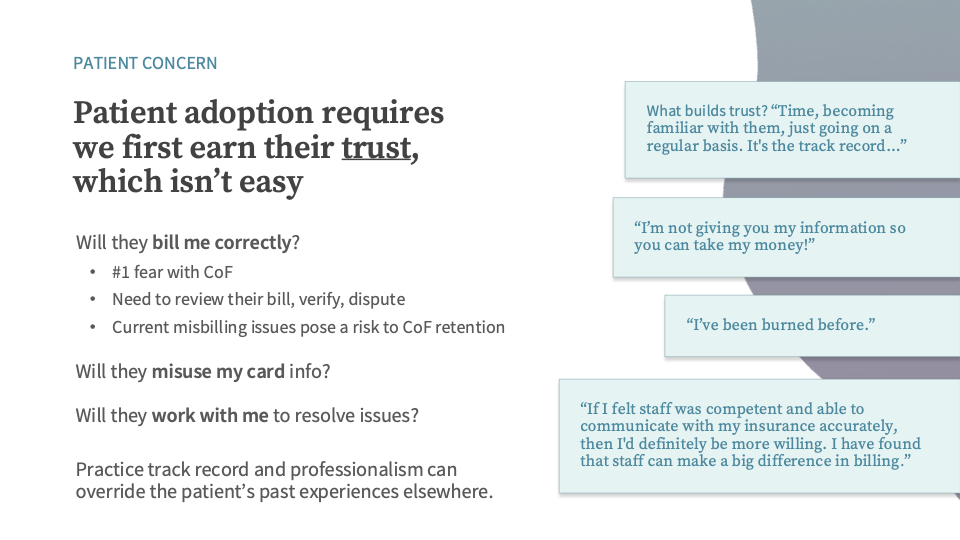
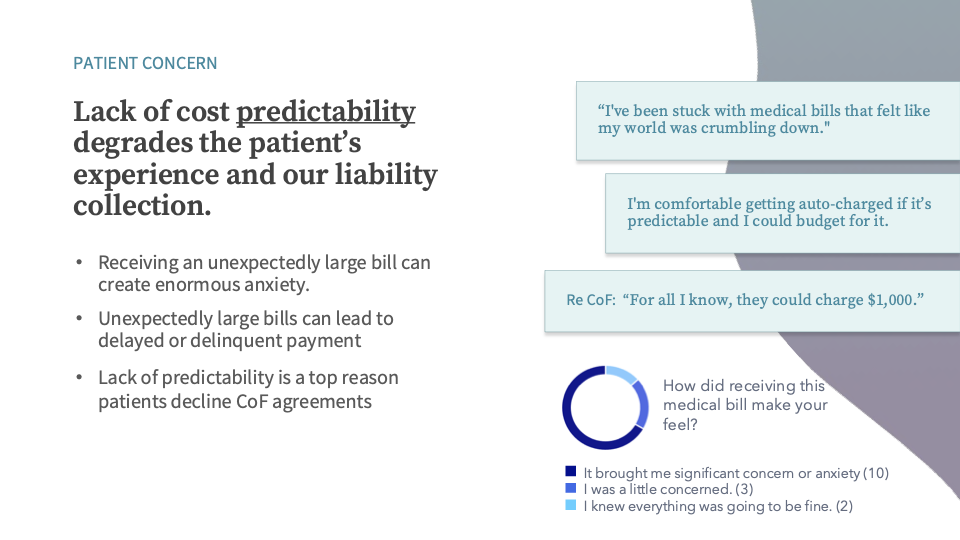
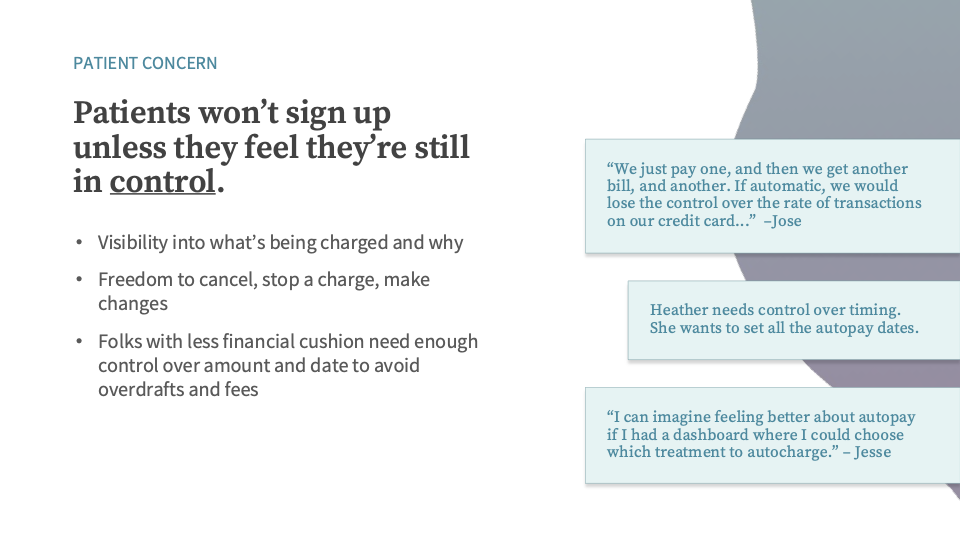
  1. Patient Fears. Patients needed trust, predictability, and control in order to enroll in autopay. With Card on File specifically, they feared being billed incorrectly and unpredictable charges.

  2. Limited access. Autopay required cardholder consent on an authorization, and the system only supported wet signature. Thus, practices could only set up autopay when the patient was in the office, despite multiple use cases for remote setup.

  3. Practice reluctance. Many practices avoided Card on File because patients didn’t get a bill before the charge, it risked auto-charging mis-billed balances, and front desk staff were unprepared to address patients’ questions and dreaded pushback.


Clear Roadmap Recommendations emerged from the findings.


1. Patients couldn’t view their bill before an auto-charge.

Finding – Patients’ #1 fear with Card on File was being billed incorrectly, yet these patients couldn’t check their bill. The charge notification email had no statement or visit details. Practice staff fielded constant calls asking what the charge was for, leading some to abandon the feature.

Recommendation – Extend our existing online bill details view to patients with an upcoming Card on File charge. This looked like a quick win, so I suggested it for the top of the roadmap.


Vision mock-up of billing notification email will new link to bill details. After legal approval, including the visit date added more immediate information.


2. Reassurance was key

Finding – Research revealed common patient fears, but also that compassion and reassurance eased them. In my survey, reassurances about card security and the ability to review and dispute the bill significantly increased positive sentiment toward autopay.

Recommendation – Lead every autopay ask—whether from a person or the system—with compassion, and address each common fear with reassurance.


Vision ideas for reassurances

3. Practices couldn’t offer autopay remotely

Finding – Most payment plans were arranged by phone with no way to collect a signature, and practices wanted to create a Card on File remotely for telehealth visits, no-shows, and to avoid bottlenecks at check-in. They needed a remote solution.

Recommendation – Build Practice-initiated Digital Consent: workflows for practice staff to email/text an autopay authorization to the cardholder for digital signature and receive confirmation of consent.


Vision mock-up for Practice-initiated Digital Consent request email


4. Front desk staff were not equipped to capture autopay

Finding – Expecting pushback, staff often avoided asking for autopay, and many couldn’t answer questions or reassure effectively. Practices that promoted autopay as a benefit saw impressive adoption rates, but doing so required training, and front-desk roles are typically entry-level positions with high turnover.

Recommendation – Build Patient-initiated Enrollment: workflows that offer or request autopay online at contextually appropriate times. This validated leadership’s assumption about needing this functionality, but for a new reason: It removes the need for staff to master the pitch and lets athenahealth control the messaging with research-backed reassurances.

Vision mock-ups for Patient-initiated Enrollment in Payment Plans and Card on File.

5. Staff can’t have less functionality than patients

Finding – Practices were enthusiastic about patient-initiated enrollment but insisted staff have every capability patients do, or they can’t help patients who get stuck. A practice-facing design partner reinforced this repeatedly.

Recommendation – Rather than build online Patient-initiated Enrollment first, as leadership expected, I recommended starting with Practice-initiated Digital Consent. In the interim, patients could continue using manual partial payment as a workaround. Once built, the digital consent workflow would enable practices to assist patients who need more flexibility than online enrollment offers.


“Sara is highly motivated and skilled at identifying and gathering the kinds of data needed to inform the vision & roadmap. Her research generated volumes of “interesting” data, but ultimately she was able to distill it down to the key points needed to move us forward.”
— UX Director / Manager


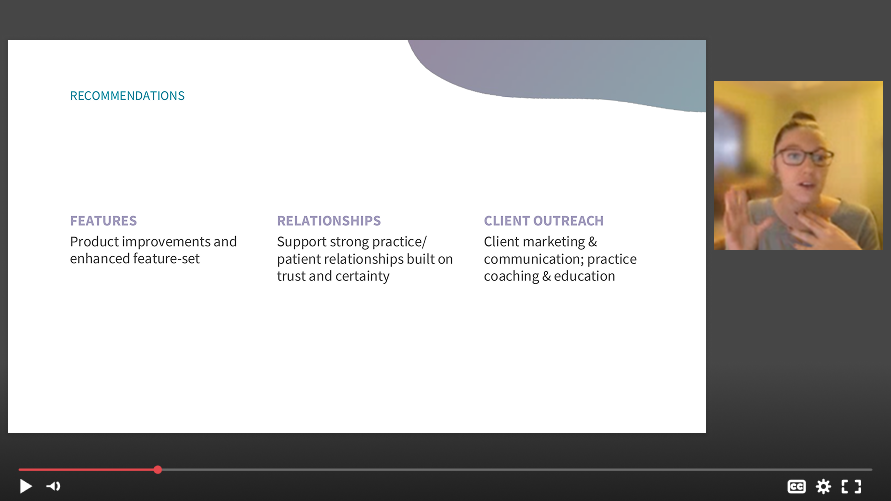
My Recommended Strategy for Autopay Adoption involved the roadmap and more:

  1. Fill Feature Gaps – Ship these recommended product improvements and features to expand access and assuage practice reluctance and patient fears.

  2. Build Patient Trust – Address patient fears by supporting practice/patient relationships built on trust, transparency, and compassion. This includes a system that behaves as expected, patient workflows that offer transparency and reassurance, and practice workflows that help staff appear competent.

  3. Conduct Practice Outreach – Equip staff to address patient fears successfully, and address practice reluctance as feature gaps fill. Consider awareness campaigns, training materials, and leveraging high adopters as evangelists.

“Sara goes beyond making a recommendation for how things should be. She puts in the extra work to answer: how can we make this a reality? Who do we need to coordinate with? What might get in the way?”
— UX Director / Manager


Success would require Executive Buy-in.


We’d identified an enormous opportunity, but it required 3 teams across 2 divisions to align objectives and roadmaps. That meant getting all Directors and VPs on board, as well as the Chief Product Officer.

Schedules are hard at that level, so I recorded a video to circulate alongside meetings. It distilled months of Payment Plans and Card on File research into one story about improving autopay utilization – highlighting the strategy and features we needed, and why it required cross-divisional partnership.

“I’m watching the [autopay] video and it is stunningly perfect. Clear, concise, actionable recommendations. You answer every question I could think of…. You’ve set the bar for others to reach.”
— Adam Prishtina, VP of Product for Patient Experience
“I found [Sara’s video] to be helpful, informative, action oriented, and pretty spot on as it pertains to [Card on File].”
— Paul Brient, Chief Product Officer


Armed with my video, team leadership secured executive buy-in and established a cross-divisional Patient Pay partnership with shared objectives.


Our new cross-divisional team needed to align around a Shared Roadmap.

Workshop Facilitation 

The team entrusted me to facilitate cross-functional roadmapping workshops with all partners and directors. I built a multi-step Mural activity to lead the group through:

  1. Aligning on each opportunity

  2. Plotting them on an effort/impact 2x2 and choosing the top opportunities

  3. Defining each team’s high-level scope, effort, and dependencies

  4. Aligning around a high-level multi-year roadmap

“[Sara’s work included] facilitating some challenging conversations with the [cross-divisional] team. Ultimately through careful listening and taking the time to give everyone a voice, she steered the group towards a plan that worked for everyone.”
— UX Director / Manager

Challenging Assumptions

Research shifted stakeholders away from their initial inclination to start with online patient-initiated enrollment. We found staff needed the functionality first, practice-initiated plans required robust configuration, and bill visibility offered a quick win for Card on File’s top pain point. The team aligned on delivering the quick win first, followed by practice-initiated solutions before their corresponding patient enrollment experiences.

“Sara has the foresight to know that if we looked at payment plans and credit card agreements more broadly, we might find other opportunities and convinced us to reframe the problem. And we did, including one that met product’s criteria for a ‘quick’ win that makes Card on File a more compelling offering. ”
— UX Director / Manager

Forming a partnership

The workshops were a success, and I went on to help lead this partnership through detailed scoping, definition, and validation of these features. My directors consistently called it one of the strongest cross-functional, cross-divisional partnerships in R&D.

“The way you’ve led [this initiative] across sub-divisions has been a big part of why our partnership with the Front Desk and Patient team is a model for collaboration that has been recognized by leadership.”
— UX Director / Manager


Beyond Autopay 

Meanwhile, Payment Plan research revealed broader insights.

  1. Medical bills invoke strong emotions. The most common reactions to large bills were shock, confusion, distrust, and anxiety. Many wonder why no one warned them of the cost.

  2. Patients don’t trust the bill. Assuming a mistake or that insurance should have covered more, they delay paying while seeking proof of what they owe.

  3. Compassion & Flexibility go a long way. Patients reported that their anxiety eased when practice staff acknowledged the bill as unaffordable, and when offered installments that fit their budget.

“I’ve been stuck with medical bills that felt like my world was crumbling down.”
— User

These findings presented opportunities for the Patient Pay team, beyond autopay.

In addition to having payment plan flexibility, bills would need to be:

  • Approachable for the anxious user. According to articles, WHO resources, accessibility guidance, and graduate papers on designing for the anxious user, this meant acknowledge the fears driving anxiety, concisely provide clear information and reassurance, and avoid friction and time pressure.

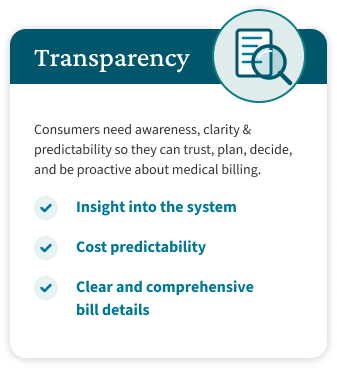
  • Transparent & understandable. Complex, opaque bills breed distrust and delay payment. When patients are confused and looking for proof, easy answers drive prompt payment.

  • Predictable. Providing cost information before and during the visit would manage expectations and reduce distrust when the bill arrives.


Four Patient Pay Experience Principles emerged.

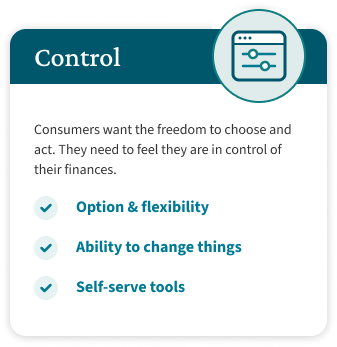
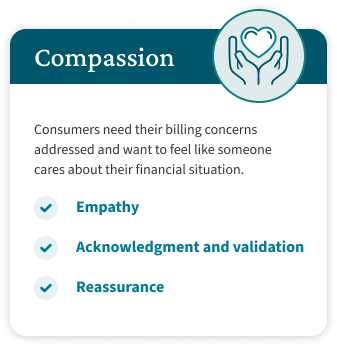
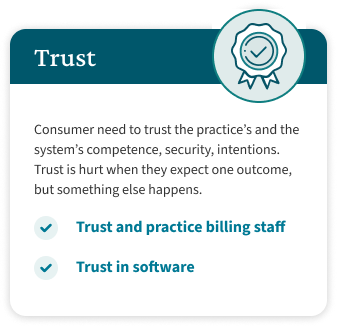
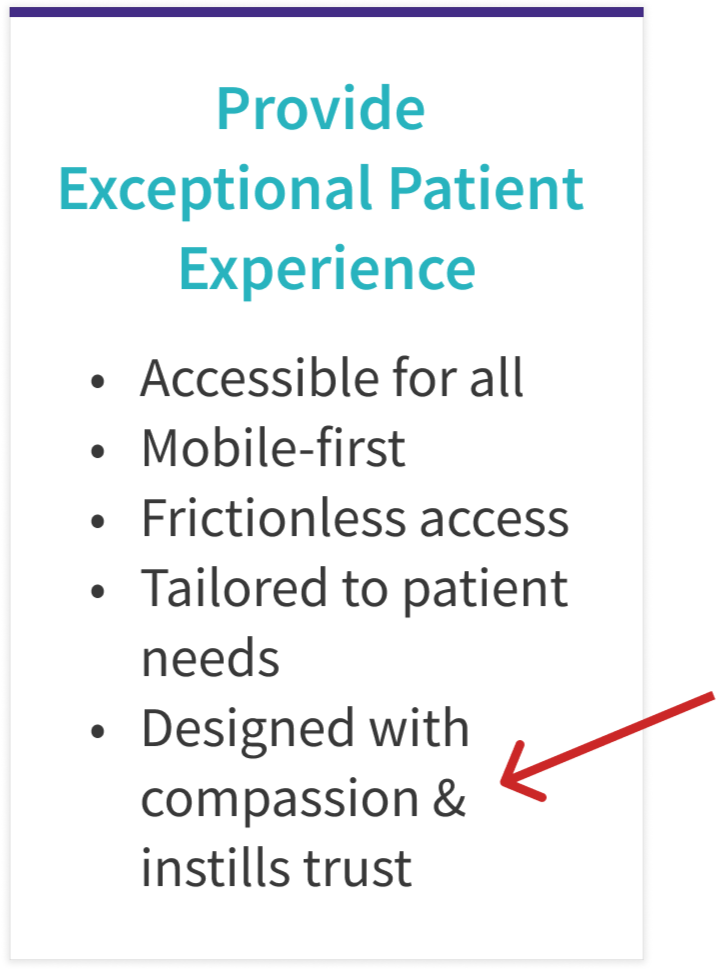
These broader patient insights—combined with the autopay findings around trust, predictability, and control—informed four experience principles for the broader patient pay space. These principles guided patient-facing billing and payment experiences for years to come, providing a framework for how to drive higher and faster payment rates, maximize autopay and prepayment adoption, and improve patient satisfaction & retention.


Visibility & predictability needs combined under Transparency, while the reassurance and anxiety findings inspired Compassion. And they all interrelate:


Outcomes


Increased Autopay Utilization

  • Payment Plans: Autopay grew from 28% to >75% since the first relevant feature launched (+7 pts after practice-initiated, +20 after patient-initiated). The first ~12-pt gain alone was projected to save $1.2M/year in statement costs.

  • Card on File: Monthly authorizations grew from 150k to 225k by 2025, then another 34% to >300k after the launch of patient-initiated enrollment.

  • Card on File control: Letting patients pay with a different card cut failed charges 50% and canceled authorizations 25%, and reduced practice burden (per surveys).

Product strategy outlined by leadership.

UX Influence

  • My readout video helped secure a cross-divisional partnership I helped lead for 5 years, recognized for its unique success.

  • The roadmap shifted substantially from original assumptions because of my research, and it held: most of what we planned got done.

  • My work shaped how our partner team structured its scrum teams.

A Strategy that Endured

  • For 5+ years, the team used my research as the north star for the autopay roadmap.

  • The four Patient Pay Experience Principles guided every patient-facing billing and payment experience we designed afterward.

  • Experience Principles entered company language and were still referenced 5+ years later.


Learnings

Fully validate before labeling a feature as a “quick win.” The bill-visibility project—which I recommended for the top of the roadmap—proved more complex than expected. Product still felt it was the right place to start, but I’ve since made fewer assumptions about LOE and pushed teams to validate early engineering estimates.

Stories, not just findings, built alignment. Sharing patient stories and quotes in readouts helped findings feel real and stick, including with the team building the roadmap. I’ve leaned on this storytelling as a communication tool ever since.

“All the data and well-justified recommendations likely would have fallen flat without Sara’s ability to draw people in with stories of the needs, fears, and struggles of real patients and customers. Themes such as patient mistrust in healthcare billing helped everyone see that it’s not just about making a workflow easier, but we actually have to address some of the fundamental challenges in healthcare in order for athena to be truly successful in the patient payment space.”
— UX Director / Manager